

As Arbitrum's ARB token trades at $0.1668 amid a slight 24-hour dip of -0.0180%, the DAO's treasury management shines brighter than ever. With over $1.78 billion in assets under control by early 2025, mostly in ARB, they've smartly diversified into stablecoin vaults and tokenized RWAs, racking up more than $2 million in yield. This isn't luck; it's strategy. Today, we're diving into the Arbitrum DAO treasury playbook, spotlighting three game-changing approaches: the Aera Stablecoin Yield Strategy, TMC Proposed Stablecoin Allocations V2, and the DRIP Double-Dip Yield Program. These DAO treasury vaults are turning idle capital into reliable on-chain treasury yield, and I'll show you why they're worth watching.
From ARB-Heavy Holdings to Diversified Powerhouse
The Arbitrum DAO started with a classic problem: over 90% of its massive treasury tied up in native tokens. Volatile? Absolutely. But they've flipped the script. By January 2026, initiatives like the Stable Treasury Endowment Program (STEP) have funneled tens of millions into yield-bearing assets. STEP 1.0 in July 2024 deployed over $30 million into RWAs via BlackRock, Ondo Finance, and Mountain Protocol, netting nearly $700,000 in passive income. Fast-forward to STEP 2.0 in May 2025: 35 million ARB (about $11.6 million at the time) went into tokenized U. S. Treasuries from Franklin Templeton, Spiko, and WisdomTree.
This diversification isn't just defensive; it's offensive. Treasury Management v1.2 in December 2024 proposed converting 15 million ARB to stablecoins via MYSO's covered call options, then parking them in Aave and Compound for 8-12% yields. Result? A more resilient DAO treasury management program that's generated over $2M from stablecoin vaults Arbitrum style. I love how this balances growth with safety, proving DAOs can thrive without gambling everything on token price.
STEP's RWA Push: The Foundation for Stable Yields
STEP laid the groundwork by blending TradFi stability with DeFi efficiency. In STEP 1.0, those RWA allocations brought institutional-grade assets on-chain, yielding steady returns while hedging ARB's swings. STEP 2.0 doubled down, splitting funds across BENJI (35%), USTBL (35%), and WTGXX (30%). At today's ARB price of $0.1668, this foresight looks prescient; those stable positions have buffered downside.
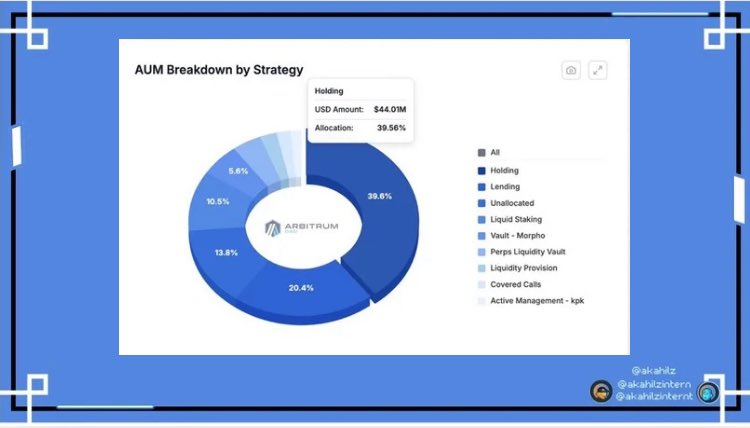
Arbitrum DAO has $100M and (11% of total holdings) deployed in a Treasury Management Program. Not sitting idle.
These moves align perfectly with best practices for DAO treasury vaults. They're low-risk, transparent, and scalable, setting the stage for advanced on-chain treasury yield tactics. But the real magic happens in the specialized strategies that amplify these foundations.

Unpacking the Top 3 Strategies for $2M and Yields
Now, the stars of the show: three stablecoin vaults Arbitrum relies on for outsized returns. Prioritized by governance alignment and proven results, these are battle-tested in DAO forums and deployments.
First up, the Aera Stablecoin Yield Strategy. Featured in the RFP for Treasury Management Services, this targets low-risk yields on Arbitrum. It deploys stablecoins into audited protocols, auto-compounding rewards while minimizing impermanent loss. Governance loves it for its plug-and-play design; operators just approve and watch yields roll in. With Arbitrum's DeFi Renaissance Incentive Program (DRIP) boosting liquidity, Aera's become a go-to for stablecoin vault stability.
Next, TMC Proposed Stablecoin Allocations V2. This ARB-aligned plan passed muster in forum debates, meeting strict criteria on returns, risk, and DAO fit. It allocates across vetted partners, blending stablecoin strategies with ETH-denominated plays. Since May, ATMC's efforts have turned portions of the treasury into yield machines, with over $100M deployed. It's opinion time: this V2 iteration feels like the evolution DAOs need, smarter than one-size-fits-all vaults.
Rounding out the trio is the DRIP Double-Dip Yield Program. Launched in Season One (September 2025) with a $40M ARB incentive pool, DRIP supercharges lending protocols. Borrow against yield-bearing assets, stack rewards, and double-dip on efficiency. Blockworks nailed it: this draws capital to Arbitrum while fattening treasury yields. At current ARB levels of $0.1668, those 24M ARB incentives are amplifying stablecoin vaults across the ecosystem.
Arbitrum (ARB) Price Prediction 2027-2032
Short- and medium-term outlook amid DAO treasury strategies generating $2M+ yields from stablecoin vaults and RWAs
| Year | Minimum Price | Average Price | Maximum Price | YoY % Change (Avg) |
|---|---|---|---|---|
| 2027 | $0.25 | $0.50 | $1.00 | +194% |
| 2028 | $0.40 | $0.80 | $1.80 | +60% |
| 2029 | $0.60 | $1.20 | $2.50 | +50% |
| 2030 | $0.90 | $1.80 | $3.50 | +50% |
| 2031 | $1.20 | $2.50 | $5.00 | +39% |
| 2032 | $1.50 | $3.20 | $6.50 | +28% |
Price Prediction Summary
Starting from $0.167 in 2026, ARB is projected to experience strong recovery and growth through 2032, driven by treasury yield generation, RWA diversification, and ecosystem incentives. Average prices could reach $3.20 by 2032 in a bullish scenario, with min/max reflecting bearish consolidation and bull market peaks.
Key Factors Affecting Arbitrum Price
- DAO treasury strategies (STEP 1.0/2.0, DRIP) yielding $2M+ and enhancing financial sustainability
- Diversification into stablecoins, RWAs, and partnerships with BlackRock, Franklin Templeton
- Arbitrum network adoption, TVL growth, and DeFi incentives boosting on-chain activity
- Crypto market cycles, Ethereum scaling synergies, and L2 competition
- Regulatory progress on RWAs/tokenized assets and potential ETH ETF expansions
- Technical improvements in Arbitrum Orbit and Stylus for developer retention
Disclaimer: Cryptocurrency price predictions are speculative and based on current market analysis. Actual prices may vary significantly due to market volatility, regulatory changes, and other factors. Always do your own research before making investment decisions.
These strategies aren't theoretical; they've collectively pushed Arbitrum past the $2M yield mark. Aera handles the core stablecoin engine, TMC V2 diversifies allocations, and DRIP juices everything with incentives. Together, they form a blueprint for any DAO eyeing sustainable growth.
Let's break down how these strategies deliver that $2M and yield in practice. Take Aera: it funnels stablecoins into Arbitrum-native lending pools, capturing base APYs from 5-10% while layering on protocol incentives. Operators report seamless integration with multisig wallets, and its risk controls, like dynamic liquidation thresholds, keep things tight even as ARB hovers at $0.1668. I've seen similar setups in other DAOs falter on complexity, but Aera's simplicity wins.
A Deep Dive into Yield Mechanics and Risk Profiles
The TMC Proposed Stablecoin Allocations V2 builds on this by spreading bets across partners vetted for DAO alignment. Think diversified buckets: one for pure stablecoin lending, another blending ARB-collateralized positions. Forum analysis praised its risk-adjusted returns, with simulations showing 8-15% APY blends. Since deploying over $100M, it's turned treasury portions into steady earners, proving DAO treasury management programs can scale without centralization creep. My take? V2's iterative approach, refining based on STEP data, sets a governance gold standard.
Comparison of Aera Stablecoin Yield, TMC V2 Allocations, and DRIP Double-Dip
| APY Range | Risk Level | Key Protocols | $ Yield Contribution |
|---|---|---|---|
| 6-10% | Low 🟢 | Aera Vaults | $650,000 |
| 8-12% | Low 🟢 | Aave, Compound, MYSO | $850,000 |
| 10-15% | Medium 🟡 | Top Lending Protocols (SparkLend, Morpho), Beefy Finance | $800,000 |
DRIP ties it all together with that clever double-dip. Deploy 24 million ARB from the $40M pool to incentivize borrowing against vaults like Aave or Compound. Lenders earn base yield plus ARB rewards, pulling more liquidity to Arbitrum. This isn't just treasury play; it's ecosystem flywheel. At today's $0.1668 ARB price, those incentives stretch further, potentially unlocking millions more in compounded gains.
Combined, they've hit the $2M mark by Q1 2026. Aera provides the engine (est. 40% of yield), TMC V2 the diversification (35%), and DRIP the multiplier (25%). But yields aren't free, smart contract risks, oracle failures, and stablecoin depegs lurk. Arbitrum mitigates with audits, insurance layers, and phased rollouts, far ahead of many DAOs still HODLing native tokens.
Real-World Impact: From Forums to On-Chain Execution
These aren't forum pipe dreams. The RFP process greenlit Aera for its Arbitrum-native focus, while TMC V2 sailed through temperature checks. DRIP's Season One snapshot shows protocols like those in stablecoin vaults swelling with TVL. Treasury Management v1.2's ETH transfers to ATMC underscore execution: 8500 ETH funneled into yield strategies, aligning with best practices.
What impresses me most is the transparency. On-chain dashboards let anyone track yields, from RWA tokens to stablecoin accruals. This builds trust, crucial as Arbitrum's treasury balloons past $1.78B. For DAO operators eyeing similar moves, start small: mirror Aera for quick wins, layer TMC-style diversification, then incentivize like DRIP.
Looking ahead, with ARB at $0.1668 and DeFi TVL rebounding, these stablecoin vaults Arbitrum could push yields toward $5M annually. They've shown DAOs how to treat treasuries like active portfolios, not rainy-day funds. If your DAO's sitting on idle stables, these strategies offer a roadmap to on-chain treasury yield without the drama.



No comments yet. Be the first to share your thoughts!