

In 2025, DAO treasury managers face a landscape where volatility remains a constant threat, but opportunities for stable, yield-generating assets have never been richer. Tokenized U. S. Treasuries have surged past $7.3 billion in market size, offering a blockchain-native way to tap into the safety of government-backed securities. Paired with stablecoin vaults, these tools are reshaping on-chain treasury management 2025, turning idle capital into productive engines for DAO sustainability. BlackRock's BUIDL fund alone manages $220 million, signaling institutional buy-in that DAO operators can't ignore.
This isn't just hype. DAOs like Arbitrum are leading by example, channeling $11.6 million in ARB tokens into tokenized U. S. Treasuries to bolster efficiency and fund ecosystem growth. Stablecoin vaults from MakerDAO's sDAI at 5.2% DSR and Ondo Finance's USDY at 5.4% yield are transforming holdings from static reserves into dynamic yield machines. Yet success hinges on smart strategies. Here, we dive into the top five ranked by relevance for DAO treasury managers: converting idle stablecoins to vaults, dynamic rebalancing, diversification across issuers, overcollateralized lending, and governance-integrated vaults.
Convert Idle Stablecoins to Tokenized US Treasury Vaults for 4-5% APY
Picture this: your DAO's USDC or USDT sitting dormant, earning nothing while inflation nibbles away. The first strategy flips that script by shifting idle stablecoins into tokenized U. S. Treasury vaults promising 4-5% APY. These vaults wrap short-term T-bills on-chain, delivering real-world yields without leaving DeFi's rails. I see this as non-negotiable for any DAO serious about capital efficiency. Platforms like Ondo and BlackRock BUIDL make entry seamless, with tokenized assets inheriting the full faith of U. S. Treasuries.
Risk? Minimal compared to volatile tokens. Yields track Fed rates closely, providing predictability. For a mid-sized DAO with $10 million in stables, that's $400,000-$500,000 annual income, funding grants or operations without selling core assets. Early adopters report seamless redemptions, proving liquidity matches stability.
Yields Comparison: Stablecoin Vaults and Tokenized US Treasuries
| Product | Yield (APY) | Provider | Notes |
|---|---|---|---|
| sDAI | 5.2% | MakerDAO | DSR (Dai Savings Rate) |
| USDY | 5.4% | Ondo Finance | Yield-generating tokenized Treasuries |
| BUIDL | ~4.8% | BlackRock | $220M AUM; Part of $7.3B market |
| USDC | 0% | Circle | Traditional stablecoin; No native yield |
Dynamic Rebalancing Protocols Between Stablecoins and Tokenized Treasuries
Markets shift fast; static allocations don't cut it. Enter dynamic rebalancing protocols, the second key strategy automating adjustments between stablecoins and tokenized treasuries. Tools like Balancer Smart Vaults or Enzyme Finance let DAOs set rules: say, 60% stables, 40% treasuries, with smart contracts rebalancing on triggers like yield spreads or risk thresholds.
This isn't set-it-and-forget-it mediocrity. It's responsive treasury management that captures alpha during rate hikes while hedging downturns. Arbitrum's STEP 2.0 nods to this, rebalancing toward RWAs for resilience. In practice, a 1% yield edge compounds massively over quarters, outpacing manual governance delays.
Opinion: DAOs ignoring automation risk treasury drag. Protocols execute 24/7, free from human bias, ensuring DAO stablecoin yield strategies stay optimized amid 2025's regulatory flux like MiCA and U. S. bills.
Diversification Across Issuers like BlackRock BUIDL and Ondo USDY
No single issuer should hold your fate. Strategy three mandates spreading bets across providers such as BlackRock's BUIDL and Ondo USDY. BUIDL's institutional pedigree pairs with USDY's DeFi-native yields, mitigating issuer-specific risks like depegs or black swan events.
Ondo USDY Technical Analysis Chart
Analysis by Sophie Caldwell | Symbol: BYBIT:USDYUSDT | Interval: 4h | Drawings: 7
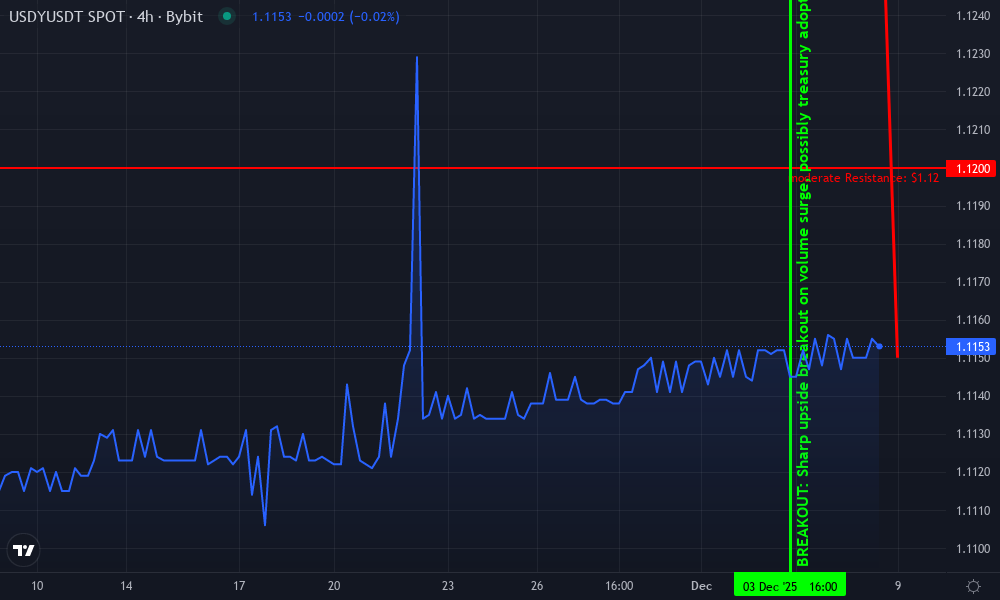
Technical Analysis Summary
On this USDYUSDT chart spanning late November to early December 2025, start by drawing a prominent downtrend line connecting the spike peak at 1.200 on 2025-12-04 to the current pullback low around 1.115 on 2025-12-09, using the 'trend_line' tool with a dashed red line for bearish bias. Add horizontal lines at key support 1.100 (green, strong) and resistance 1.120 (red, moderate). Mark the climactic volume spike on 2025-12-04 with an upward arrow_marker in blue at the base of the candle. Use fib_retracement from the spike low 1.110 to high 1.200 to highlight 50% retracement at 1.155 as potential entry zone. Draw a rectangle for the pre-spike consolidation from 2025-11-20 to 2025-11-30 between 1.098 and 1.105. Place a vertical_line on 2025-12-04 labeled 'News Spike?' and text callouts for MACD bearish crossover post-spike. Finally, add long_position marker near 1.105 support and short_position at 1.120 resistance for swing ideas.
Risk Assessment: medium
Analysis: High volatility from spike but USDY's stablecoin-RWA nature caps downside; DAO treasury trends supportive long-term, but short-term exhaustion risks whipsaw
Sophie Caldwell's Recommendation: Swing long on dip to 1.105 with tight stops—yield accrual makes holding attractive amid 2025 tokenization boom
Key Support & Resistance Levels
📈 Support Levels:
- $1.1 - Strong prior consolidation base, aligns with 38.2% fib strong
- $1.095 - Nov lows, minor support weak
📉 Resistance Levels:
- $1.12 - Immediate overhead from pullback highs moderate
- $1.155 - 50% fib retracement of spike, key hurdle strong
Trading Zones (medium risk tolerance)
🎯 Entry Zones:
- $1.105 - Bounce from strong support in consolidation zone, volume drying up suggests reversal medium risk
- $1.098 - Deeper dip to weak support for higher RR swing long high risk
🚪 Exit Zones:
- $1.14 - Profit target at 61.8% fib extension or prior swing high 💰 profit target
- $1.155 - Next resistance confluence 💰 profit target
- $1.092 - Below strong support invalidates long 🛡️ stop loss
Technical Indicators Analysis
📊 Volume Analysis:
Pattern: climactic spike on breakout then declining
Massive volume on Dec 4 spike indicates exhaustion, now contracting—bullish divergence potential
📈 MACD Analysis:
Signal: bearish crossover post-spike
MACD histogram contracting after bullish surge, lines crossed down signaling pullback momentum
Applied TradingView Drawing Utilities
This chart analysis utilizes the following professional drawing tools:
Disclaimer: This technical analysis by Sophie Caldwell is for educational purposes only and should not be considered as financial advice. Trading involves risk, and you should always do your own research before making investment decisions. Past performance does not guarantee future results. The analysis reflects the author's personal methodology and risk tolerance (medium).
Arbitrum DAO exemplifies this, blending stables like USDC, USDT, DAI with RWAs. Data shows diversified treasuries weather storms better: on-chain U. S. Treasuries ballooned from $4 billion early 2025 to over $7 billion by June. For DAO operators, this means lower volatility, steadier yields, and sleep-at-night confidence. Start small, 20% per issuer, scaling as conviction builds.
Read more on optimization at this guide. These moves position tokenized US treasuries DAOs ahead of the curve.
Overcollateralized Lending Using Treasury Holdings as Collateral
Why stop at base yields when you can stack them? The fourth strategy leverages overcollateralized lending, depositing tokenized U. S. Treasuries as collateral on platforms like Aave or Morpho to borrow stablecoins at low rates. Repay or loop the borrowed funds back into vaults for compounded returns, pushing effective APYs toward 7-8% in favorable conditions.
This appeals to my risk-averse side while chasing upside. Tokenized treasuries serve as pristine collateral, prized for their stability and low liquidation risk. A DAO posts $1 million in BUIDL, borrows $800,000 USDC at 2% against it, then vaults the USDC for 5% yield. Net gain: treasury yield minus borrow cost, all automated. Arbitrum's treasury could amplify its $11.6 million allocation this way, funding more grants without diluting tokens.
Watch for oracle risks or flash loan exploits, but overcollateralization at 150% and keeps things safe. In 2025's maturing DeFi, this bridges TradFi security with on-chain leverage, supercharging DAO treasury tokenized treasuries.
Governance-Integrated Vault Strategies with On-Chain Voting
The pinnacle? Governance-integrated vault strategies, where on-chain voting directly controls treasury vaults. Snapshot or Tally proposals trigger smart contract executions: approve a rebalance, and vaults adjust instantly. This fifth strategy fuses community input with automation, ensuring decisions reflect tokenholder will without off-chain delays.
Imagine proposing a shift from 50% stables to 30% USDY and 20% lending positions; votes execute via Aragon or DAOstack integrations. MakerDAO pioneered this with DSR toggles, now extending to treasuries. For DAOs, it democratizes on-chain treasury management 2025, reducing whale dominance and execution slippage.
Governance Tools vs. Execution Time in DAO Treasury Management
| Governance Tool | Execution Time | Yields Preserved |
|---|---|---|
| Snapshot | Days | 100% |
| Tally and Vaults | Minutes | 100% |
| Enzyme | Instant | 100% |
Opinion: Pure genius for alignment. No more forum wars; votes mint real yield. Scroll's RFP highlights SCR strategies tying governance to capital efficiency, a blueprint for others.
Diversified across BlackRock BUIDL and Ondo USDY, these strategies - from idle conversions to voting vaults - build treasuries that withstand volatility. Tokenized U. S. Treasuries at $7.3 billion market cap underscore the momentum, with stablecoin vaults like sDAI and USDY delivering reliable 5.2-5.4% yields. DAOs embracing dynamic protocols and lending see compounded growth, much like Arbitrum's STEP evolution. Operators, audit your allocations today: shift to these for resilience in DeFi's next phase. Check shifting strategies here for deeper dives.



No comments yet. Be the first to share your thoughts!