

The Arbitrum DAO treasury has emerged as a model for on-chain treasury management, quietly amassing over $2 million in yield by January 2026 through disciplined, ecosystem-aligned strategies. What began as idle holdings of ARB tokens and ETH has transformed into a diversified portfolio leveraging tokenized real-world assets (RWAs) and liquid restaking, all while prioritizing capital preservation. This isn't yield chasing; it's a calculated push toward sustainability in a volatile DeFi landscape.

Arbitrum's success stems from recognizing that DAO treasuries must evolve beyond simple holding. With a treasury once valued at around $1.3 billion, primarily in ARB and ETH, the DAO faced the classic challenge: how to deploy idle assets without exposing them to undue risk. The answer lay in native DeFi protocols and institutional-grade products, generating revenue while bolstering the Arbitrum ecosystem's transaction volume and TVL.
Stable Treasury Endowment Program: Locking in Predictable Yields with Tokenized Treasuries
The cornerstone of Arbitrum's DAO treasury yield strategies is the Stable Treasury Endowment Program (STEP). Launched in July 2024, STEP Phase 1 directed over $30 million into tokenized U. S. Treasury products from trusted issuers. This move yielded nearly $700,000 in passive income within months, proving the viability of RWAs on Arbitrum. By bridging traditional fixed-income assets onto the chain, the DAO secured stable returns uncorrelated with crypto volatility.
Phase 2, confirmed in May 2025, escalated commitment by allocating 35 million ARB, valued at approximately $11.6 million, to partners like Franklin Templeton, Spiko, and WisdomTree. These tokenized treasuries offer yields from U. S. government securities, directly supporting Arbitrum treasury program goals of stability and growth. Unlike speculative DeFi plays, STEP emphasizes risk-adjusted returns, with principal protection baked in through overcollateralization and audited smart contracts.
ArbitrumDAO has confirmed the next phase of its Stable Treasury Endowment Program (STEP), allocating 35 million $ARB to tokenized US treasury products. (Source: PR Newswire)
This RWA integration isn't just about yield; it's ecosystem flywheel activation. Every dollar parked in these products increases on-chain activity, fees, and sequencer revenue, creating a virtuous cycle for Arbitrum's L2 infrastructure.
Beyond Treasuries: Liquid Restaking Powers Treasury Diversification
While STEP provides the stable base, Arbitrum's on-chain treasury management shines in its bold diversification into liquid restaking. The DAO deposited 3,117 ETH into ether. fi's weETH on Arbitrum, positioning it as the third-largest holding. This strategy captures dual yields: Ethereum staking rewards plus liquidity provision incentives, all without sacrificing accessibility.
weETH enables the treasury to earn while remaining flexible for governance needs. In a market where ETH strategies weathered price dips to still produce $53,000 in yield, including Lido rewards, the restaking layer adds efficiency. Arbitrum DAO treasury managers astutely balanced this higher-risk tranche against STEP's conservatism, deploying roughly 11% of assets into active plays exceeding $100 million total.
Critically, these moves align incentives. By favoring Arbitrum-native DeFi, the DAO drives TVL and volume, amplifying ARB's utility. Idle assets no longer sit dormant; they're productive engines for long-term sustainability.

Risk Management as the Unseen Yield Multiplier
Generating $2 million-plus demands more than opportunity; it requires ironclad risk controls. Arbitrum's playbook, detailed in governance forums, stresses diversification across asset classes and protocols. ETH allocations mitigate ARB concentration risk, while RWAs hedge crypto downside. Strategies undergo rigorous RFP processes, vetting for audits, historical performance, and Arbitrum integration.
Even amid ETH price declines, yields persisted, underscoring resilience. This DAO treasury yield strategies framework, blending traditional portfolio theory with on-chain analytics, sets a benchmark. Operators elsewhere should note: true alpha emerges from disciplined allocation, not leverage chases.
Explore how Arbitrum DAO's program generates sustainable yield.
Performance at a Glance: Treasury Allocations and Yields
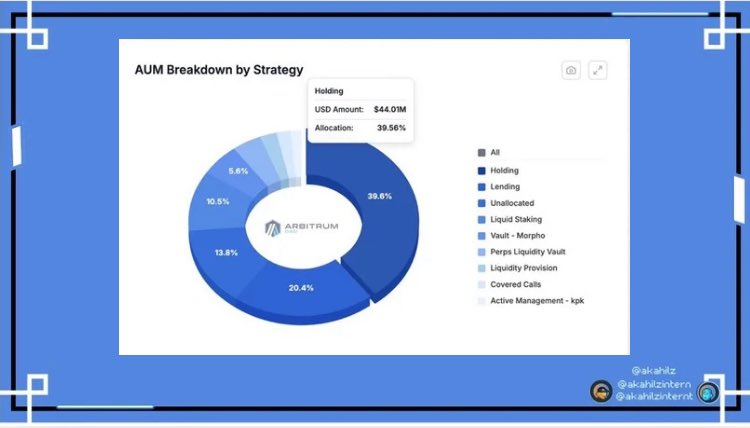
Arbitrum's treasury dashboard reveals a portfolio engineered for balance. Over $100 million-11% of total assets-now powers active strategies, blending low-volatility RWAs with restaking upside. This selective deployment avoids overexposure, targeting on-chain capital efficiency through audited protocols.
Arbitrum DAO Treasury Breakdown
| Strategy | Allocation | Yield Generated | Risk Profile (Low/Med/High) |
|---|---|---|---|
| STEP Phase 1 | $30M RWAs | $700K | Low |
| STEP Phase 2 | 35M ARB (~$11.6M) | Ongoing | Low |
| weETH | 3,117 ETH | ETH staking and liquidity | Medium |
| Total Active | $100M+ | $2M+ | Balanced |
These figures, drawn from governance snapshots and partner reports, highlight yield persistence. STEP's tokenized treasuries delivered steady accrual from U. S. securities, while weETH compounded Ethereum rewards on Arbitrum's network. ETH positions, even through downturns, netted $53,000 including stETH drops, validating the mix. DAO treasury managers track metrics like Sharpe ratio equivalents via on-chain analytics, ensuring strategies outperform holding by 2-5% annually on a risk-adjusted basis.
Such transparency empowers voters. Snapshot votes and RFP scrutiny enforce accountability, with proposals mandating exit clauses and rebalancing triggers. This data-centric approach turns treasury ops into a public good, replicable for any DAO eyeing sustainable growth.
Ecosystem Flywheel: Yield Reinvestment Fuels Arbitrum's Defi Orbit
Arbitrum DAO treasury strategies extend beyond numbers; they catalyze network effects. Deployments into native DeFi-like ether. fi restaking spike TVL, sequencer fees, and ARB demand. Tokenized RWAs, settled on Arbitrum, boost transaction volume, indirectly padding treasury via revenue shares. It's a self-reinforcing loop: yields fund grants, builders bootstrap dApps, activity begets more capital inflows.
Consider the DRIP initiative's ethos-transferring ETH to aligned multisigs for yield and ecosystem bets. Scaled up, this mindset positions Arbitrum as L2 leader, with treasury as growth engine. Other DAOs, from Compound's COMP yield plays to Scroll's RFPs, echo this: sustainability hinges on productive assets aligned with tokenomics.
Yet Arbitrum stands out by quantifying impact. Post-STEP, RWA TVL on Arbitrum jumped, drawing issuers like Franklin Templeton deeper into crypto. weETH integration similarly spotlights restaking as treasury primitive, blending security with liquidity for DAO stablecoin vaults analogs in volatile holdings.
Breakdown of Arbitrum's $85M and RWA-ETH diversification.Risk never vanishes, but Arbitrum mitigates via diversification caps-no single strategy exceeds 20%-and oracle redundancies. Governance evolves too, with agentic treasuries on horizon for automated rebalancing. Operators debating idle ARB piles should audit their stacks against this blueprint: audit protocols, align incentives, harvest yields methodically.
The $2 million milestone cements Arbitrum as benchmark for Arbitrum treasury program excellence. In DeFi's maturity arc, treasuries like this prove DAOs can rival VCs in capital stewardship, turning tokens into enduring endowments. Forward-thinking operators will adapt these plays, scaling security-first growth across chains.




No comments yet. Be the first to share your thoughts!